ProQual Level 3 Award in the Inspection & Testing of Fire-Resisting Door Installations (Ofqual 603/4995/5)
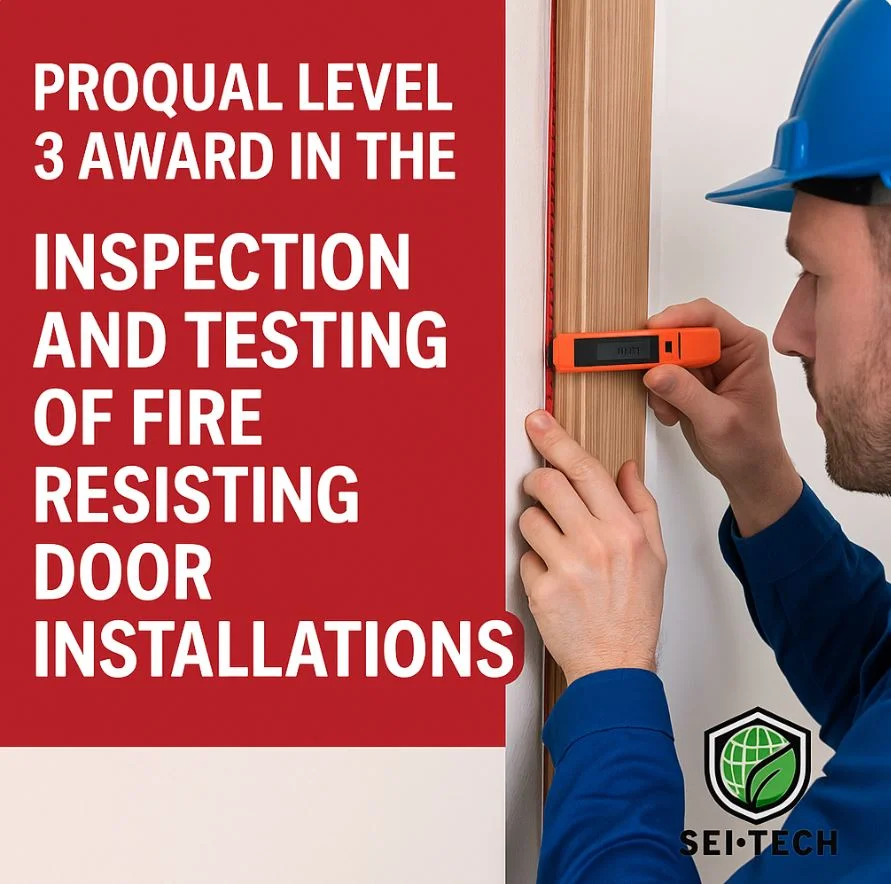
ProQual Level 3 Award in the Inspection and Testing of Fire Resisting Door
Course Overview
The ProQual Level 3 Award in the Inspection and Testing of Fire Resisting Door Installations is a nationally recognised qualification that confirms a learner’s competence in assessing and testing fire-resisting door installations in accordance with current fire safety legislation and industry standards.
This qualification is designed for professionals responsible for ensuring that fire doors comply with regulatory requirements and perform effectively in the event of a fire.
Candidate Entry Requirements
For Fire Door Installers
Learners who are currently installing fire doors are expected to hold the:
ProQual Level 2 Diploma in Installing Fire Resisting Timber Door-sets
For Supervisors and Responsible Persons
Candidates in supervisory or responsible roles must demonstrate appropriate health and safety knowledge, typically evidenced by qualifications such as:
SMSTS (Site Management Safety Training Scheme)
SSSTS (Site Supervisor Safety Training Scheme)
All training centres are required to carry out an initial assessment of each learner’s existing skills and knowledge to identify any gaps and plan appropriate assessment activities.
Course Structure
The qualification is delivered over three structured days, covering theory, practical application and formal assessment.
Day 1 – Core Knowledge and Fire-Rated Timber Doorsets
1. Core Module
This module introduces the key legislation, regulations and principles that underpin fire protection systems, along with the fundamentals of fire behaviour and fire testing.
Building Regulations
Learners gain an understanding of UK Building Regulations, with particular focus on fire protection requirements and construction industry standards, including:
Approved Document B
Passive and active fire protection measures
Relevant guidance documents, including the Regulatory Reform (Fire Safety) Order
Installer and product certification
UKCA marking requirements
Fire and Fire Testing
This section explores fire behaviour and how fire testing is conducted in laboratory environments, including:
Large-scale fire resistance testing
Small-scale material and component testing
Differences between UK British Standards and European fire testing standards
Case studies of significant fires over the past 50 years
2. Fire-Rated Timber Doorsets Module
This module focuses on the design, purpose, specification and installation of fire-rated timber doorsets.
Topics include:
The purpose and function of fire-resisting doors
Definitions and components of a complete doorset
Fire testing methods for doorsets
Types of timber fire-rated doorsets
Supporting construction and wall-to-frame requirements
Door leaf installation and configuration
Essential ironmongery and hardware components
Intumescent seals and smoke seals
Vision panels, including side panels and overpanels
Learners also explore how correct installation and ongoing maintenance help prevent the spread of fire and smoke throughout a building.
Day 2 – Fire Door Maintenance and Repair
This module concentrates on the inspection, maintenance, repair and compliance requirements for fire-resisting doors.
Key Topics
Legal responsibilities under the Regulatory Reform (Fire Safety) Order 2005
Considerations when changing components and maintaining system integrity
Detailed maintenance procedures for timber fire doors
Maintenance of door frames, leaves, seals, vision panels and ironmongery
Acceptable substitutions and limitations for hardware components
Preventative maintenance strategies for high-traffic environments
Maintenance principles for steel, composite and fabric fire doors
Refurbishment of heritage and older fire doors
Troubleshooting common issues such as binding doors, excessive gaps or failure to self-close
Day 3 – Practical Training and Written Assessment
Practical Training
Learners take part in hands-on inspection activities, including:
Practical group exercises
Software-based inspection recording
Real-world inspection scenarios
Written Assessment
A written assessment consisting of 52 questions must be completed.
A minimum pass mark of 75% is required to progress to the final practical inspection assessment.
Successful candidates will be allocated a date and time for their Level 3 Inspection Assessment.
Final Assessment – Level 3 Inspection Assessment
Once the written assessment has been successfully completed and all learning criteria have been met, learners undertake the final inspection assessment on an allocated date.
Successful completion confirms competence in the inspection and testing of fire-resisting door installations in accordance with current fire safety regulations.
Qualification Details
Awarding Body: ProQual Awarding Body
Regulator: Ofqual
Framework: Regulated Qualifications Framework (RQF)
CPD Hours: 40
Professional Recognition: Recognised by the Institution of Fire Engineers (IFE)
This is a competence-based qualification, requiring learners to demonstrate both theoretical understanding and practical ability against all learning outcomes and assessment criteria.
Conclusion
The ProQual Level 3 Award in the Inspection and Testing of Fire Resisting Door Installations provides professionals with the knowledge, practical skills and recognised certification required to ensure fire door compliance, safety and performance — supporting safer buildings and improved fire protection standards.